
A splotch of black mud sits around the cold steel brace on the railing of my apartment balcony. The sun sinks over downtown Detroit, radiating off a slim green blade of grass that in a world of concrete and mortar has somehow sprouted, as if had no other splotch of mud been found over the entirety of earth, here it would find its home, by the railing, overlooking life below.
Life perseveres. Always. Somehow. That is its quintessential quality.
In the oldest page in our book I read, “Naked I came from my mother’s womb, and naked shall I return.”1 Is not the sanctity of life defined by its insistence, that perhaps the most ancient part of our genome is to suffer through the dirt?
I think Job realized this. And so beautiful the writer of his story captures the rise and fall of humanity. We are born from mud, we are exposed, and we fall back into the earth in worship, that maybe to love God in our fullest is to fall on our face, battered and defeated by the winds and rains, yet still say, somehow, Christ is Lord.
“Then Job arose and tore his robe and shaved his head and fell on the ground and worshiped.”2

I confess confusion with the movement in evangelical Christianity that preaches a gospel of victory and prosperity in life when so clearly the text we follow unanimously shouts that to live is to suffer. We do not serve a God who came with an army of angels to topple an authoritarian regime3 but who came to suffer alongside us, care for us, heal us, walk with us.4 Jesus revealed the fullness of both divinity and humanity5, that to be God is to love and to be human is to suffer. His life is defined by both.
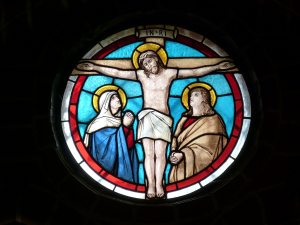
To follow Christ was not to excuse suffering but to find meaning in it. His dearest friends were all killed for their dedication to him, except one.6
I love John so dearly because I can see clearest through his eyes. He snuck through the muddied crack of the world to live and persist. The longevity of his life afforded him the unique perspective to write from the end of life, which results in a gospel we cannot fit so cleanly in the synopsis of Christ’s life. In his years, John saw the first martyr of Christ—his brother—and wept the last. His friends were killed. His family was killed. I imagine he would spit at the feet of the preacher who says that God wants to give him wealth and influence.
Actually, I imagine he would weep and speak softly, “Let me tell you about Jesus of Nazareth.”
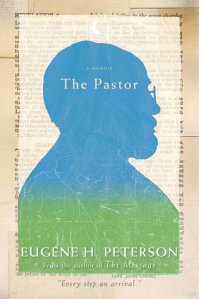
The striking realization of those that read scripture today is that the division between what our churches teach and what Jesus taught is entrenched and growing. Eugene Peterson said, “The church in which I live and have been called to write and speak has become more like the culture . . . than counter to it.”7 Peterson’s father was a butcher and his mother an ordained minister. And somehow that knowledge alone gives me insight into his writing, that perhaps from an early age he was accustomed to blood and death and sacrifice and sanctity.
On his death, Robert McFadden wrote a piece in the New York Times headlined, “Eugene H. Peterson, 85, Scholar Turned Homespun Pastor, Dies.”
Although he had been ordained by the Presbyterian Church USA for teaching purposes, he had never seriously considered life as a minister. But in 1962, his denomination asked him to found a new church in Bel Air and to become its pastor. He took the plunge, and found an adventure.
“It wasn’t much,” Mrs. Peterson recalled in a recent interview for this obituary. “We started in our home, in the basement. Eugene went knocking on doors, telling people we were beginning a new church. And that first Sunday, 46 people showed up.”
It was a revelation for Mr. Peterson. “I thought, ‘Wow, the church is a lot more interesting than the classroom,’” he told Religion News Service in 2013. “There’s no ambiguity to Greek and Hebrew. It’s just right or wrong. And in the church, everything was going every which way all the time — dying, being born, divorces, kids running away. I suddenly realized that this is where I really got a sense of being involved and not just sitting on the sidelines as a spectator, but being in the game.”
I think, in some small way, this reflects John’s life. I imagine him living with Mary, years later, living out the love his best friend taught him. Someway Jesus had given him a life with his family, and from a young age I think John must have received a profound lesson from that.
Of course, the Son of Thunder still got himself thrown in jail, preached a radical message of love to his enemies, and formed an early church that would explode into a movement through centuries. But I think the power of his message came from the deep grief in his heart. Perhaps he tells his story not to preach a sermon but to remember his friends. So at the end of his time, John writes from a life of suffering that knows deep in the root of his heart, “The Lord gave, and the Lord has taken away; blessed be the name of the Lord.”
[1] Job 1:21
[2] Job 1:20
[3] Matt. 26:53
[4] See Isaiah 53:3, 1 Peter 2:21, 1 Peter 3:18, 1 John 2:6
[5] Colossians 2:9
[6] John 21:18-23
[7] Eugene Peterson. Living the Resurrection: The Risen Christ in Everyday Life. NavPress: 107-08.
 Regarding Life