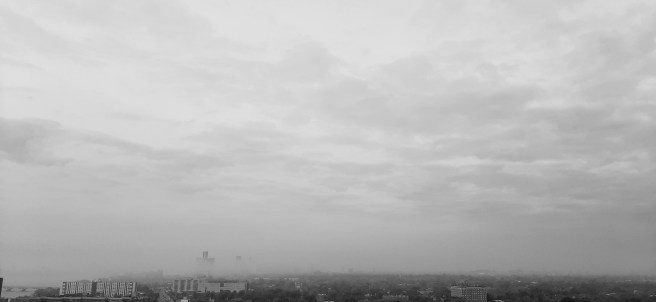
When the fog rolls over Detroit, I immediately lose sight of the city. Within moments, skyscrapers, steel, lights, signs, wonders, all disappear. Gone. The Ambassador Bridge, usually lining the horizon with spots of brightness, stoops into the river, grayed water seamlessly melting into blank sky. The world melts to bleakness.
I live over a marina, which is now mostly empty. The air is cold but somehow startlingly fresh. The park next to the water sits idle, swings squeaking softly in the breeze, the base of the steel slides collecting puddles. The earth is dying.
Yet, in this desolate place, I still hear a distant laugh as a father lifts his child into that swing. A bright red coat waves up and down as, for a moment, the playground remembers the life it once contained. As swift as it began, it ends. Chilled, but smiling, the father walks his son home. And the swing slowly settles, motionless above the wet mulch, next to the marina, where a handful of boats still drift in place waiting to be covered and picked out of the water, like a toddler in the tub.
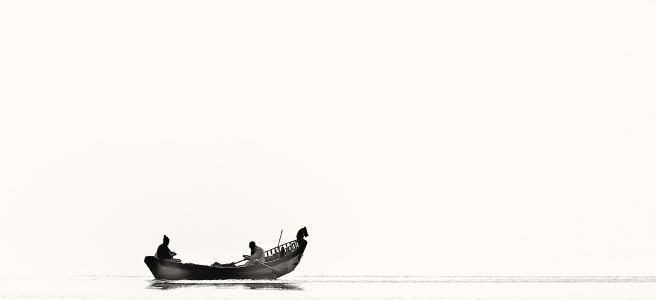
John sailed through many wet and cold nights. He worked with his brother, James, and their father in the family owned business, which I imagine titled Zebedee and Sons. They docked and lived in a small town called Bethsaida (literally, “House of Fishing”), which sits where the Jordan empties into the Sea of Galilee. From the boat, John spent nights watching the small-speckled lights on the shore slowly extinguish into dark gray shapes as his father cast the nets into the night.1
Zeb had several hired hands and copartners, two of which were the rascals (and dear friends to his sons) Andrew and Peter.2 Andrew had recently started following an outspoken and crazed activist who had been preaching and baptizing people just up the river. His name was Jehohanan, and they called him the Baptist.3 I imagine Andrew told stories to James, and John turned his ear to eavesdrop, about this man with wild hair who was rumored to eat only bugs and honey. He yelled about repentance and change and the coming of the Messiah, the Messiah his people had waited and watched for through their lives and their father’s lives and their grandfather’s lives. I would love to sit in that small fishing town and hear Zebedee talk over a cup of tea, if they had it, with a little milk and sugar, if they had it.
He watched as his sons’ friend told stories of the Baptist, looking out the corner of his eye at John. Was John too impressionable? Was he too young to be exposed to political unrest? Would he be let down when, like his father and his father’s father, the Messiah Zebedee looked for never showed up?

I think John took after his mother. We have no evidence to think he did. But I think he did. Her name was Salome.4 Somehow I think she looked like Golde from Fiddler on the Roof. And of course, she sang beautifully at the return of her husband and sons after a night fishing. Except one morning, Zebedee hauled a load to shore, the seats on his boat empty, his sons gone.
A man had called them from the shore. They had nothing. He said to cast their nets on the other side of the boat. He said that to a boat of expert fishermen. A boat of expert fishermen who had fished all night.5
But somehow Zebedee had to explain it. He had to explain that his sons had left the business. I wonder if they just left. I wonder if Salome cried. I wonder if Zebedee held her.
Certainly, they saw their sons in the years to come. They came back and had dinner and told stories of this supposed Messiah. Zebedee and Salome soon met him. I wonder if they said, “Take care of our sons.” I wonder what his eyes said in response.
Like the fog rolling over the sea, Zebedee lost his business overnight. No longer and Sons, just and Co. No good father would regret his children following their passions and living fully. No good father would hold dry eyes to their absence. I think he especially worried for John, who was young, maybe unmarried. Not even his father’s wildest dreams could have imagined the life that laid in front of his son. John would lose everything he held dear. But we would gain everything he held dear. He outlived his friends. He was banished and imprisoned on an island, the sea taunting him with the laps of waves he used to sail, his father calling directions, Peter asking for clarification constantly.
Like the steel statues of the city, the people John loved disappeared suddenly as the clouds formed near the ground and he lost sight of them, he lost sight of the shore, he lost sight of where he was going. But then he remembered a man he had met once who changed his course. And so with each day he rowed and said, “Abide in love.”
1 John 4:16
[1] For further reading, see The Beloved Disciple: Following John to the Heart of Jesus by Beth Moore. Broadman and Holman. 2003.
[2] See Mark 1:20, Luke 5:10
[3] See Matthew 3:1-12
[4] Compare Mark 15:40 and Matthew 27:56
[5] See Luke 5:1-11
 Regarding Life