Content warning: statistics of drug use, depression, and suicide are discussed in this article.
Preface
To those in the church, I want to talk about the casualties of American Evangelicalism, specifically those casualties who are queer. I will not be talking about biblical texts as they relate to homosexuality or marriage. I am unwilling to enter this war of opinion not only because those more qualified than myself have given reasonable exposition on both sides but because, as my queer sister says, the queer people in our congregations do not need biblical evidence to justify their presence or service in the church. They are welcome simply and only because the kingdom of heaven is given to them.
The story
Matthew once told me a story about a farmer with two adolescent sons, both on summer break. The farmer, rising early one morning, told his sons to prune the orchard. The youngest, tired and indigent, told his dad to pound sand. The oldest, thinking better of it, told his dad he would work after breakfast. In a few hours, however, it was the youngest son who the farmer found in the orchard, while the oldest never showed up.
Jesus told this story to several church elders. He asked them which of the two sons did what the father had asked.
“The youngest,” they said.
“Yes,” Jesus responded, “and I tell you that crooks and whores are going to precede you into God’s kingdom. It will be taken back from you and handed over to a people who will live out a kingdom life.”1
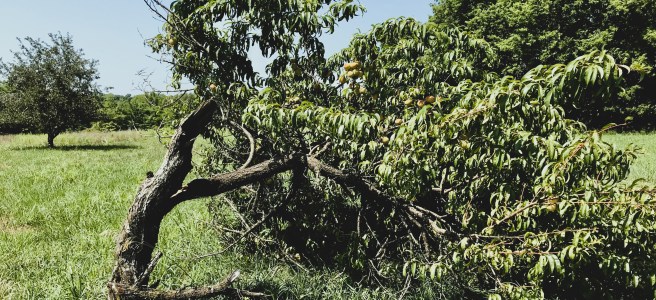
Last year around August, I was tending my own orchard. The fruit on several peach trees were just beginning to ripen. One tree in particular had fallen in a storm months before. A small piece of its stringy trunk and bark, bent to the breaking point, somehow remained connected to the base of the trunk, to the roots of the tree. This tree produced hundreds of beautiful peaches, even though it was broken and lying flat on the ground. Sometimes we’re a mess, but, like a duck on the pond, abundant and explosive life beats just below the surface.
Mark remembered walking with Jesus one morning, hungry for breakfast, when they saw a thick and beautiful fig tree from a distance. Approaching it, though, they found it fruitless. Mark overheard Jesus talking to the tree. Even though it was still early in the season, Jesus cursed it for being barren. It died the next day.2
“People don’t pick figs from thorn bushes, or grapes from briers.” Jesus said.3
Religion is excellent at training us to say the right things and look the right way. In Jerusalem, they made a business out of this. But Jesus shut them down, teaching that the fruit of our actions bears witness to the condition of our heart.
“God’s Way is not a matter of mere talk; it’s an empowered life,” Paul wrote.4
I want to look at the fruit of non-affirming theology in American Evangelicalism. Before I do, I want to introduce you to Jan. When she was a teenager, Jan liked to talk to Gertrude, her older neighbor across the backyard. “Her loving friendship showed me how powerful it is to be readily available to others,” Jan said, “to listen, to care for them, to engage with their lives.”5 In the years that followed, Jan became that older neighbor. She was a person known for her unhurried conversations. Her listening was a kind of soaking and absorbing attentiveness. I have the sense that, had we the time to sit and chat, she would ask those kind and sensitive questions that are only asked by people who sincerely desire to know you. I want to invite you to hear the stories of the queer folks who have left your church. These are not my stories to tell. But, should we begin cultivating these unhurried conversations, I believe we will begin to mend this brokenness.
The fruit
Compared with their heterosexual peers, LGBTQ youth are
200% more likely to be bullied,
200% more likely to use illicit drugs
200% more likely to feel persistently sad or hopeless
300% more likely to inject illegal drugs
300% more likely to make a suicide plan
400% more likely to attempt suicide6
LGBTQ youth who reported family rejection were
340% more likely to use illegal drugs
590% more likely to report high levels of depression
840% more likely to attempt suicide7
Youth who heard negative religious comments from their parents about being LGBTQ were
200% more likely to attempt suicide8
In 2013, 75% of LGBTQ adults said that evangelical churches were hostile towards them.9
Community rejection and negative attitudes towards LGBTQ persons lead to internalized emotional distress and suicidal behaviors.10
Conflict between religious and sexual identity lead to depression and suicide in LGBTQ adults.11
Parental anti-homosexual religious beliefs are associated with chronic suicidal thoughts in LGBTQ persons.12
Parental religious beliefs about homosexuality are associated with suicide attempt in LGBTQ persons.13
To this Christianity, I have only one response: to bear witness to the causalities of a theology that defends beliefs at the cost of bodies.
Epilogue
“What are we growing?” I asked.
“This is asparagus,” she replied. “It grows quickly, and we must be ready to harvest it. But some living things take much longer to grow, and the trouble is knowing when to wait and when to act.”
“Why do some things take longer to grow,” I asked, and I was worried she’d be impatient like she is sometimes when I ask too many questions. But she wasn’t. She looked up, out, over the orchard and the field and the hills. She took a deep breath and smiled.
“Well, I don’t know for sure.” She spoke slowly and seemed to speak from a place deep down, below her chest, something planted deep inside her. “I know that some plants grow more above ground, and some plants grow more underground, and some creatures grow more inside, and some creatures grow more outside. Some creatures grow quickly, and some creatures, like you,” she nodded, “will never stop growing. You’ll just keep on growing until you outgrow your body, and then God will call you home until he can make a body full enough and whole enough to hold you. And when that day comes, the Lord himself might just give you the answer to his secret.”
“What secret?” I asked, and I knew that this was the last question I could ask for a while.
“The secret that happens between the moment when I plant this seed,” she said, as she pushed her fingers deep in the dirt next to the asparagus plant, “and when its stem will sprout up through the earth and receive the light.”
Additional notes
A note for families: Family acceptance overwhelmingly promotes better mental and physical health for LGBTQ youth.14
A note for church folks: Communities that resolve conflict between LGBTQ identity and religious traditions are quantitatively better for the wellbeing of LGBTQ persons.15
A note for LGBTQ youth: If you are feeling hopeless, please, please reach out. You can go to https://www.thetrevorproject.org/ for help.
A note for churched LGBTQ youth: God does not hate you. I know this because I read his book. He says that you are his masterpiece. Research shows that giving up on your faith can lead to isolation and depression.16 Find a community who will support you and love you no matter what. Don’t argue theology as a way to justify your presence in a congregation. Reach out if you need a safe place to discuss queerness and the Bible. Go to https://geekyjustin.com/great-debate/ for some safe conversation.
References
- Read Matthew 21 (MSG)
- Read Mark 11
- See Luke 6.44 (NIV)
- See 1 Cor 4:20 (MSG)
- See https://www.christianitytoday.com/ct/2018/october-web-only/eugene-peterson-jan-my-life-as-pastors-wife.html. Read more about Jan Peterson in A Burning in My Bones by Winn Collier.
- https://npin.cdc.gov/publication/youth-risk-behavior-survey-data-summary-trends-report-2007-2017
- https://pubmed.ncbi.nlm.nih.gov/19117902/
- https://www.thetrevorproject.org/research-briefs/religiosity-and-suicidality-among-lgbtq-youth/
- https://www.pewresearch.org/social-trends/2013/06/13/chapter-6-religion/
- https://www.ncbi.nlm.nih.gov/pmc/articles/PMC4706071/
- Ibid.
- Ibid.
- Ibid.
- https://pubmed.ncbi.nlm.nih.gov/21073595/
- https://www.ncbi.nlm.nih.gov/pmc/articles/PMC4706071/
- https://www.ncbi.nlm.nih.gov/pmc/articles/PMC470
 Regarding Life