
Written in collaboration with Stephanie Reynolds.
Deporting people from this land back to the land in which they were born for the simple reason that they do not have the correct paperwork to justify their presence in this land is morally wrong.1 Because I am Christian, my morality comes from Christ.2 This means that deportation is not only morally wrong, it is anti-christlike.3
80% of evangelicals voted for Donald Trump from 2016 through 2024, again4 and again5 and again.6 Most white evangelical churches support him and his policies.7 Some pastors vocally support him.8 Most pastors will not directly speak about him. If evangelical pastors rebuked him, I expect most of their congregation would leave.9 Some evangelical congregants would rather find another church than examine our own fundamentally flawed view of morality.10
The deportation practices in the United States are wrong. This is not new; but, it is worse. Most evangelical Christians actively or passively support these deportations.11 This means the belief of most evangelical Christians is not like Christ. There are several possible reasons for this. First, we do not care about Christ. Second, we are unwilling to submit ourselves to Christ. Third, we do not know Christ. These options are troubling for me.
When Jesus comes again, he will not judge his children who have crossed a man-made line on a map without paperwork. He will not judge his children who have crossed a river without documenting it on a material that is made from trees and then dyed with ink and sealed with wax. These are symbols that men who dress up as kings pretend have significance.12
Make no mistake: the borders we draw on maps, the fences we erect upon property lines, and the blood we shed over figments of imagination that we draw in ink—these are the property of Satan, not Christ. For the Christian, these maps and papers are nonsense.
When Jesus comes again, he will judge a people who took bountiful plenty from the land they occupy,13 who set themselves up to be the beneficiaries of all riches from all lands,14 and who did not share those riches.15 He will judge a nation who oppressed the innocent and deprived the poor of justice. He will judge a nation who refused refuge to strangers.
These statements do not require complex hermeneutics. These statements do not require degrees from seminary. These statements do not require intensive historical context. This morality is written onto our hearts;16 it is written onto the hearts of the people crying in our streets; it is carved deep into the rocks that, from the depths of the earth, will cry out in the silence of a people who claim to follow Christ.17
The kingdom of God respects no man-made borders. The kingdom of God is open to all people, its gates open and left unguarded. In the kingdom of God, there are no foreigners. Deportation is not the way of Christ. Deportation was never the way of Christ. Deportation is anti-christlike.
Churches in America are filled with American ideas, not Christian ideas. Americans may argue over immigration policy. Americans may vote for immigration policy. Americans may debate immigration policy. Christians have one obligation: to welcome the stranger. This is a commandment from the Lord we claim to follow.18 Follow him.
If our church building is not a safe place for undocumented families, tear it down. We have built a kingdom in the name of someone other than Christ.
If a movement does not act like Christ, talk like Christ, and live like Christ, the movement is not Christian. Take his name off our building and desecrate his message no longer.
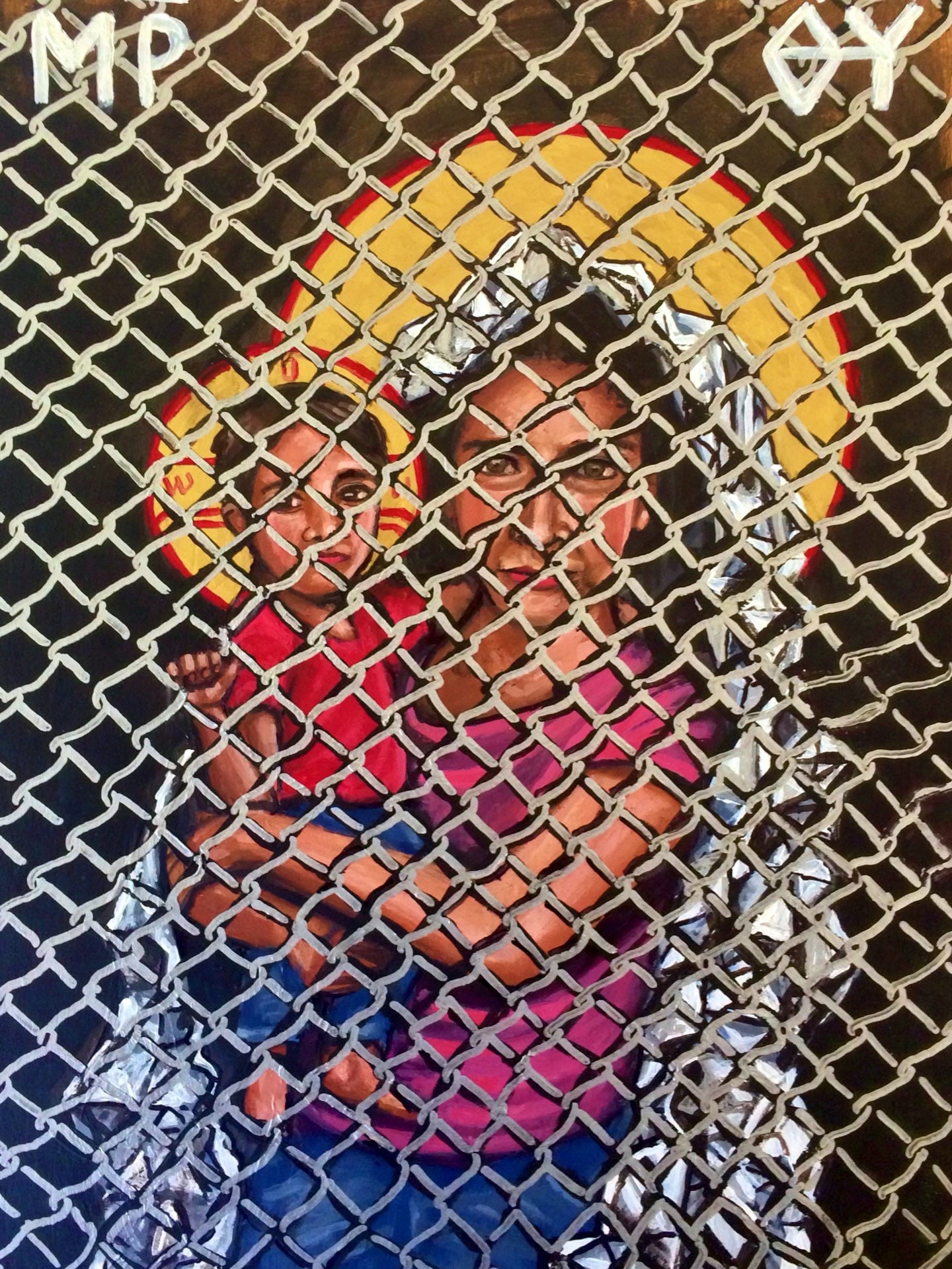
Christ welcomes migrants from every corner of the earth. He shares the excess of his food. He provides warm shelter in the cold. He works in community with those who are eager. Children ask him, “¿Quieres jugar con nosotros?”, and he chases after them as they scream with joy. He is found in the eyes of the man hiding an undocumented family from immigration officers. This is Jesus, Lord of all creation. Paperwork is not required to enter his jurisdiction. Does he have our allegiance? Or do we pledge to uphold the law of this empire? We cannot serve both. We cannot serve Jesus and Donald Trump. We cannot serve the Kingdom of Heaven and the United States of America.
We can, however, inasmuch as empire gives us sayso, shout and vote and stand between the guns and our undocumented neighbors. We can turn our church buildings into sanctuaries. We can share our resources and our land and our warmth with those seeking refuge. We can advocate for the disenfranchised in courts of law, in pulpits, in town halls, and in the streets. From Orange County, California to San Juan, Puerto Rico, we can ask, “Will you be my neighbor?”
This is what it looks like to follow Christ in times of upheaval. Will you join me?
Love,
John
APPENDIX & END NOTES
This appendix is for people who are genuinely interested in examining their own theological beliefs as they relate to their politics. This appendix is neither an argument in favor of liberal political orientations nor a comprehensive overview of theological systems that are more liberatory than the systems espoused in conservative evangelical churches. It is simply a Scriptural and facts-based defense of the words penned above.
- The hebraic view of land presented in scripture is one of stewardship, not ownership (Leviticus 25:23). Thus, the idea of removing someone from the land was absurd. In fact, the opposite was true. Radical hospitality to foreigners was required for God’s people (Leviticus 19:34, Deuteronomy 10:19), evidenced in practices of gleaning rights (Leviticus 19:9-10), sabbatical years (Leviticus 25:3-4), and jubilee (Leviticus 25:10). This was a central theme in the Torah, which gave foreigners equal rights under the law (Exodus 12:49). According to hebraic tradition, Abraham’s tent was open on both sides because he often rushed out to greet wayfarers. These practices were reinforced by Jesus and his earliest followers (Matthew 25:35, Hebrews 13:2, Acts 10:34-35, Ephesians 2:19), an extension of the second-greatest commandment Jesus gave his followers (Matthew 22:39-40).
- This view, called a Christocentric hermeneutic or “cruciform hermeneutic,” is not commonly held by evangelicals. For an overview of the cruciform hermeneutic, see Boyd, “Four Principles of the Cruciform Thesis.” For an overview of its criticisms, see Copan, “Greg Boyd’s Misunderstandings of the Warrior God.” For a response to the criticisms, see the Paul Copan tag on Boyd’s website, ReKnew.org.
- 1 John 2 speaks extensively of antichrist. The chapter opens with a discussion of what a true believer in Christ looks like—someone who obeys the commands of Jesus, living “as Jesus did” (1 John 2:6). John elaborates by explaining what it looks like to live in the way of Jesus: “Anyone who loves their brother and sister lives in the light, and there is nothing in them to make them stumble” (1 John 2:10). After giving his reasons for writing (verses 12-14), then warning against loving “the world” (kosmos: order, system), John clearly defines antichrist: “It is whoever denies that Jesus is the Christ” (1 John 2:22). In this way, it is clear that an antichrist is anyone who denies that the life, death, and resurrection of Jesus Christ revealed the true nature of God, either in their words or in the way they live their lives.
- https://www.pewresearch.org/short-reads/2016/11/09/how-the-faithful-voted-a-preliminary-2016-analysis/
- https://www.pewresearch.org/short-reads/2021/08/30/most-white-americans-who-regularly-attend-worship-services-voted-for-trump-in-2020/
- https://www.pewresearch.org/short-reads/2024/09/09/white-protestants-and-catholics-support-trump-but-voters-in-other-us-religious-groups-prefer-harris/
- https://www.pewresearch.org/short-reads/2026/02/09/white-evangelicals-remain-among-trumps-strongest-supporters-but-theyre-less-supportive-than-a-year-ago/
- According to Lifeway Research, half of protestant pastors in the US support Donald Trump, including pastors, leaders, and theologians like: Bill Johnson, Wayne Grudem, Franklin Graham (son of Billy Graham), Paula White-Cain, Mark Burns, Jack Graham, Robert Jeffress, Eric Metaxas, James Dobson, Greg Locke, Albert Mohler, and Sean Feucht.
- Hart, Dru. Making it Plain: Why We NEED Anabaptism and the Black Church.
- Back in my day, we used to call this type of church hopping “McChurch,” implying that people were not interested in being challenged and went to different churches out of convenience or ease of message.
- https://prri.org/research/the-new-immigration-crackdown-where-americans-stand/
- Revelation 7:9
- Leviticus 25:23
- Proverbs 28:25
- Leviticus 23:22
- Romans 2:15
- Luke 19:40
- Matthew 22:37-39; Mark 12:30-31
 Regarding Life