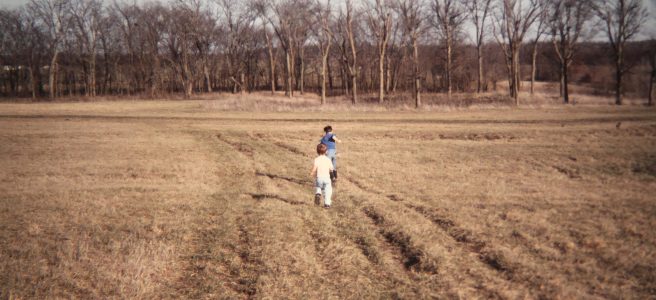
When I told my mom that the neighbor had cut down the trees in the large field at the bottom of our hill, she cried. This practice—removing hedge rows and wooded plots—is commonly used in agriculture to maximize yields per acre. It makes sense for my neighbor to maximize his yields. It makes sense for my mother to cry.
The land used to belong to our family. It witnessed her and my father raising three boys. We took walks through those woods and found shade under the branches. On Mother’s Day, my grandma and all her children and grandchildren would visit, share a meal together, and fish at the pond under those trees. We all fished. My grandma loved to fish with us.
There’s a photo on my wall that almost looks like a painting: my grandma and a small boy standing with fishing rods at the edge of the pond. The water is flanked by tall waving cattails and a few tall oaks casting their shadow on its rippling surface.
Planting a tree is a job for a prophet. Trees move at a different pace from our own—slow, steady, the rings on their trunks measuring years like the second hand on a clock. These creatures witness our lives and the lives before us, and if left unbothered, the lives after us. Coming back to a tree planted a lifetime ago is a humbling experience. Here it is, now, in the same place, the same soil, forty or fifty feet taller: a colossal standing between you and the sky.
Have you watched a tree? You can’t see it grow. Overnight, small sprouts appear in secret, roots tunnel unseen through the ground. Seasons come and go. The breadth and height of the tree is both inevitable and sudden. This is the quintessential sign of growth, always moving but its pace immeasurable. We can only observe it in frozen frames like a picture book of running horses.
When we look up and marvel at a tree we knew as a child, our astonishment reveals more about our own soul than the reality of the tree. It has accomplished nothing more than every tree before it: to stand in place and grow with each day. Our great surprise is that while the landscape has changed, our heart still feels like that child, and we wonder where the distance went between that child and us now.
Trees remind us of our mortality. We are just migrants, passing through this place. The trees are here to stay, rooted and immovable. Half of its life is left underground and unseen. We often feel the same, the invisible parts of our soul witness to a lifetime of rain and drought, laughter and sorrow, life and death.
It makes sense that my mother cried. She saw that invisible half the rest of us could not see: the small boys playing under their branches, tying ropes to the limbs of their trunks, swinging with the sounds of shrieking unburdened joy.
Those boys are men now, and those trees are gone. They were cut down by my neighbor, and my mother cried.
 Regarding Life
Thanks for sharing this. Wonderful experiences in important settings. I wish you might have shared the picture. Cheers! 🏄♂️